The research places our experience within a wider question for Africa’s development: how do we support the people and communities through which lasting change becomes possible?
When The Bridgespan Group sets out to explain what makes Africa’s social impact centres distinctive, its new report begins with SINA.
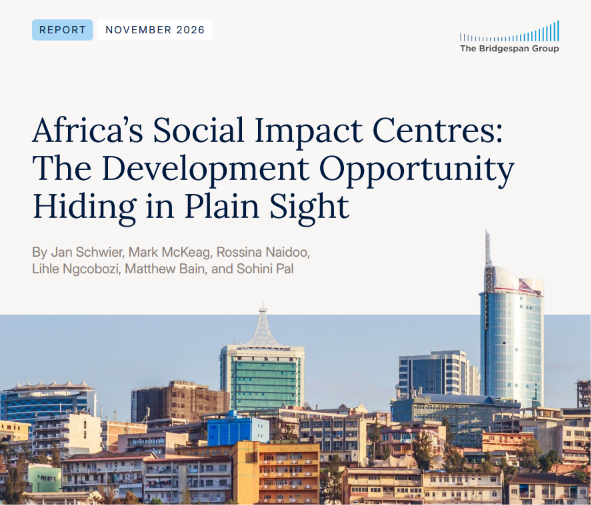
On pages 5–6 of Africa’s Social Impact Centres: The Development Opportunity Hiding in Plain Sight, the authors describe how we bring education, personal development and entrepreneurship together through communities that scholars run and co-own. SINA is their first example of organisations whose work crosses the boundaries of familiar institutional categories.
When you visit one of our SINA Communities you might get confused because you might see a learning space, a meeting about community finances and a young social enterprise finding its first customers all in parallel. Each reveals something about SINA and understanding how they relate is key for us. Through the SINA Framework, we the scholars take responsibility for the communities in which we learn. Budgets need to balance, conflicts need attention, decisions affect other people and consequences are part of the learning. We call this freesponsibility: freedom joined with responsibility. It requires structure and room to make mistakes without someone immediately taking over.
The report captures the relationship between this experience and enterprise creation through the words of our founder, Etienne Salborn:´“The enterprise grows out of the person and the community.” A social enterprise needs someone able to exercise judgment, work with others and respond when an idea fails. Those capacities develop through the work of holding a community together. As scholars create opportunities for others, personal development begins to shape the conditions in which more people can develop.
This is why the research matters to our communities, partners and supporters. It offers a way to understand work whose value can be difficult to see when education, employment and entrepreneurship are considered separately. Published on 16 November 2026, the report was developed by The Bridgespan Group with the Bertha Centre for Social Innovation and Entrepreneurship as its thought partner. We contributed our experience through the research process in several interviews.
The accompanying article, The Case for Funding Africa’s Social Impact Centres, recommends investing in organisational capability, covering the costs of collaboration and supporting ecosystem coordination. It also asks funders to reconsider measurement expectations where change develops over long periods and through relationships between organisations. For us, those recommendations reach into practical decisions.
Flexible funding can help us strengthen the conditions in which responsibility becomes workable: capable facilitators, reliable financial systems, safeguarding and time to learn from difficult experiences. These foundations influence what happens long after a particular training session ends. Funding collaboration means making it possible for SINA Communities to learn together. A community navigating a difficult transition may have experience another urgently needs. Sharing it requires time, trust and people able to accompany one another. Those costs are real, even when the resulting learning cannot be assigned to a single project. Coordination raises a further question for us: does the support we provide increase each community’s ability to act?
Our direction is to develop shared tools and support that allow SINA communities to carry more of the movement themselves. Shared governance infrastructure, replication teams and learning across communities should help responsibility travel outward. The test is whether more people can make decisions and create the conditions for others to do the same. Evidence becomes useful when it helps us examine our decisions and change our practice.
The report gives our supporters a broader context for what they help make possible. Behind a social enterprise stands a founder, and around that founder are relationships, responsibilities and opportunities to learn. Supporting those conditions is an investment in what a community may become capable of creating next.
Read the full report here: