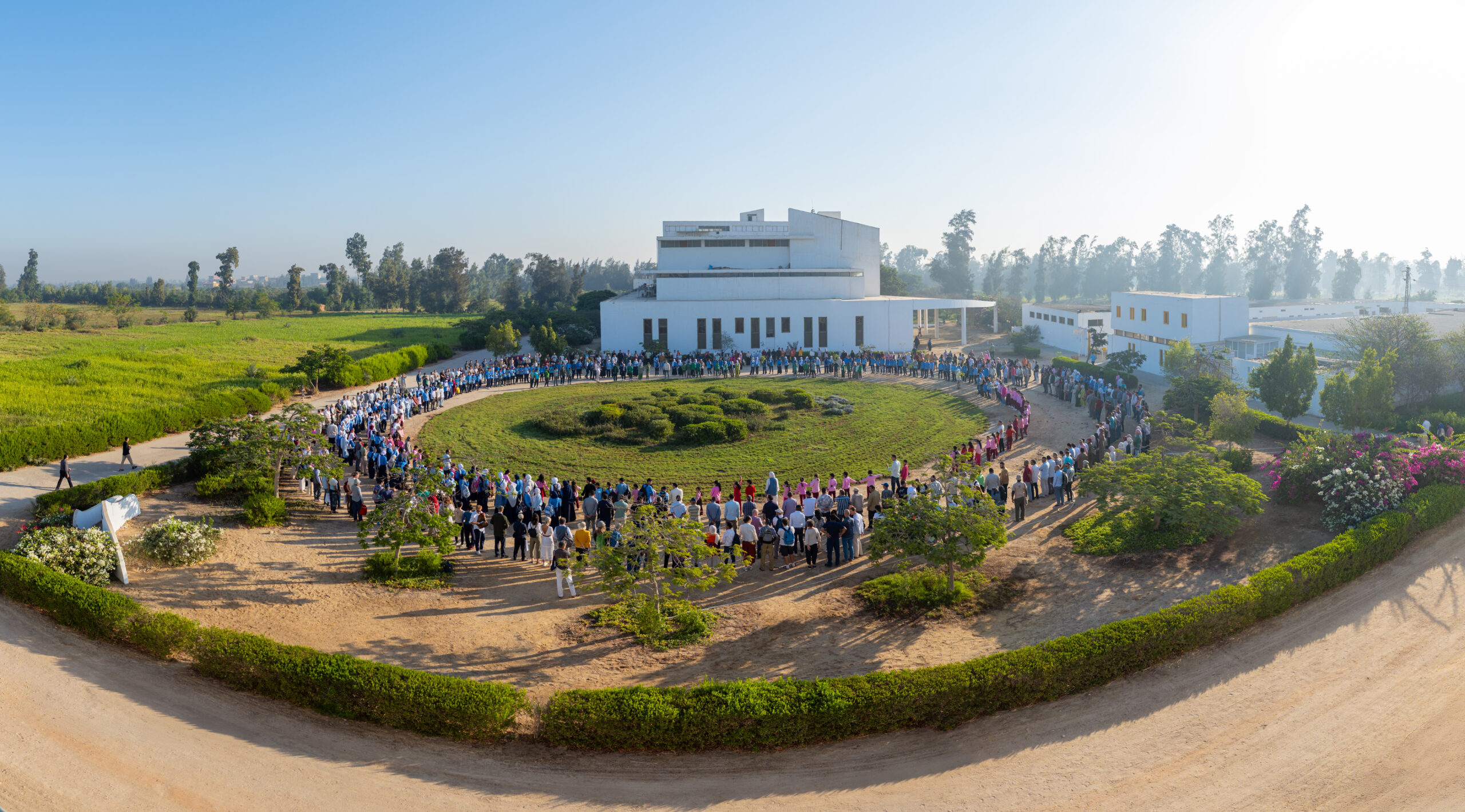
Five SINA delegates from three Ugandan SINA Communities went to Egypt to learn from a living model of regeneration. Over five days from 24–28 September 2025, they joined farmers, educators, scientists and social entrepreneurs at the World Goetheanum Forum in SEKEM, Egypt, an event explicitly framed to “re-think, re-feel and re-do” sustainable development. The whole event was organised by the World Goetheanum Association in partnership with Heliopolis University and SEKEM—UNEP’s 2024 Champion of the Earth—with program partners including Heliopolis University.
Representing SINA were Morris Micheal Ojok and Eva Kirabo of Tunaweza Innovation Hub (Bombo), Kalindi Brian of Kamuli Innovation Academy and Charles and Birugi of Kiira Innovation Academy (Nyenga). They were greeted in Cairo by Uganda’s embassy in Egypt before heading east into SEKEM’s green campus—an oasis built over decades on formerly barren desert land and now a working showcase of biodynamic agriculture, community health, education and culture. “It’s not just about farming. It’s also about how a community lives, learns, and grows together,” said Ojok, reflecting on the first morning circle with music and poetry before field visits.


SEKEM set the context. Founded in 1977 by Dr. Ibrahim Abouleish, the initiative has spent nearly five decades greening the desert through biodynamic methods, circular resource use and renewable energy, while linking farm enterprises to education and arts that nurture the whole community. Its program with the Egyptian Biodynamic Association scales regenerative practices across thousands of farmers through standards such as Economy of Love.
The Forum itself was deliberately practical. Organizers framed the days around building the individual and collective capacities needed to make sustainable development tangible across sectors and scales, inviting participants to craft a shared “new narrative” grounded in action. For the SINA delegation, the learning cut across soil, school and society. Kirabo described the regenerative farm tours as a turning point: compost made from local organics, drip irrigation and careful crop rotations protecting soils in a water-stressed landscape, and solar integrated into daily operations. “Seeing barren land bloom through dedicated effort and smart systems was a wake-up call. Our hubs can do the same with waste and neglected spaces,” she said after a session on circularity. SEKEM and SINA both foster regenerative communities with mindset shifts, self-organization, and real-world impact.
Education at Heliopolis University gave the visitors a second anchor. Labs and studios sit alongside community projects so that students test ideas with real users and real fields—a cadence the Forum encouraged all participants to adopt. The Forum’s stated aim—to fuse practices across places and cultivate the capacities that “serve all forms of life”—mirrored that intention.
Culture threaded the experience. Morning reflection, music and poetry at SEKEM modeled how communities can align purpose before work begins. Kirabo put it simply: “Standing in the desert, surrounded by green life and music, I realized regeneration is not theory—it’s lived experience.” Those rituals resonated with SINA’s own “freesponsible” approach, in which young people gain freedom with accountability and co-create their learning by taking real roles in their communities and ventures. SINA’s purpose—“regenerative communities in a freesponsible world”—and its five-stage empowerment framework already push scholars to turn past adversity into social enterprises; the Egyptian field lessons now give them new regenerative tools to add.
Back home, the SINA Communities are translating impressions into action. Delegates outlined early steps: short daily reflection circles to build focus and cooperation; waste audits and compost pilots linked to demonstration gardens; and inter-hub exchanges so ideas travel fast—one morning circle, one compost heap, one applied project at a time.